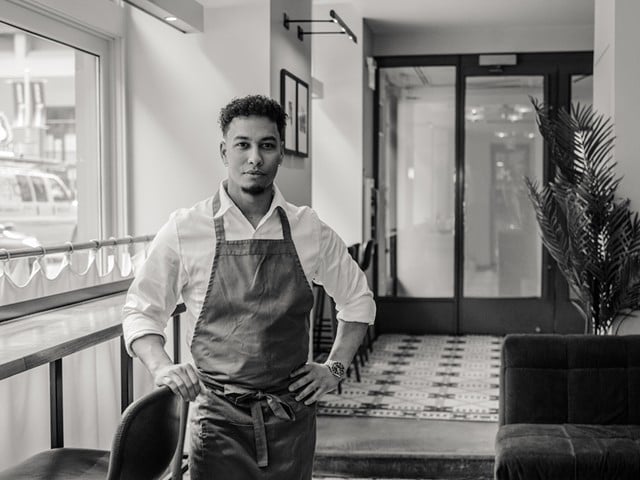
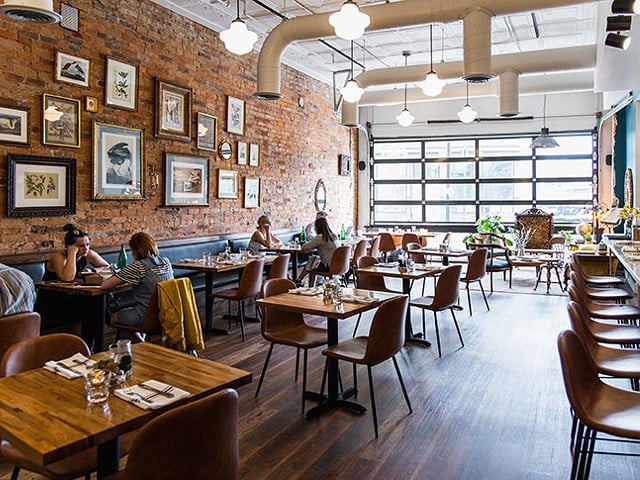
[Multimedia show: Brian Madison of Madison's at Findlay Market discusses the "buy local" movement in Greater Cincinnati.]
HSBC, one of the biggest banks on the planet, has taken to calling itself “the world’s local bank.” Winn-Dixie, a 500-outlet supermarket chain, recently launched a new ad campaign under the tagline, “Local flavor since 1956.” The International Council of Shopping Centers, a global consortium of mall owners and developers, is pouring millions of dollars into television ads urging people to “Shop Local” — at their nearest mall. Even Wal-Mart is getting in on the act, hanging bright green banners over its produce aisles that simply say, “Local.”
This new variation on corporate “green washing” — local washing — is, like the "buy local" movement itself, most advanced in the context of food. Hellmann’s, the mayonnaise brand owned by the processed-food giant Unilever, is test-driving a new “Eat Real, Eat Local” initiative in Canada.
The ad campaign seems aimed partly at enhancing the brand by simply associating Hellmann’s with local food. But it also makes the claim that Hellmann’s is local, because most of its ingredients come from North America.
It’s not the only industrial food company muscling in on local. Frito-Lay’s new television commercials use farmers as pitchmen to position the company’s potato chips as local food, while Foster Farms, one of the largest producers of poultry products in the country, is labeling packages of chicken and turkey “locally grown.”
Corporate local washing is now spreading well beyond food. Barnes & Noble, the world’s top seller of books, has launched a video blog site under the banner, “All bookselling is local.” The site, which features “local book news” and recommendations from employees of stores in such evocative-sounding locales as Surprise, Ariz., and Wauwatosa, Wis., seems designed to disguise what Barnes & Noble is — a highly centralized corporation where decisions about what books to stock are made by a handful of buyers — and to present the chain instead as a collection of independent-minded booksellers.
Across the country, scores of shopping malls, chambers of commerce and economic development agencies are also appropriating the phrase “buy local” to urge consumers to patronize nearby malls and big-box stores. In March, leaders of a new Buy Local campaign in Fresno, California, assembled in front of the Fashion Fair Mall for a kick-off press conference. Flanked by storefronts bearing brand names like Anthropologie and The Cheesecake Factory, officials from the Economic Development Corp. of Fresno County explained that choosing to “buy local” helps the region’s economy.
The real ‘buy local’ movement
In one way, all of this corporate local washing is good news for local economy advocates: It represents the best empirical evidence yet that the grassroots movement for locally produced goods and independently owned businesses now sweeping the country is having a measurable impact on the choices people make.
“Think of the millions of dollars these big companies spend on research and focus groups. They wouldn’t be doing this on a hunch,” says Dan Cullen of the American Booksellers Association (ABA), a trade group that represents 1,700 independent bookstores and last year launched IndieBound, an initiative that helps locally owned businesses communicate their independence and community roots.
Signs that consumer preferences are trending local abound. Locally grown food has soared in popularity. The U.S. is now home to 4,385 active farmers markets, one out of every three of which was started since 2000. Food co-ops and neighborhood green grocers are on the rise. Driving is down, while data from several metropolitan regions show that houses located within walking distance of small neighborhood stores have held value better than those isolated in the suburbs.
A growing number of independent businesses are trumpeting their local ownership and community roots, and reporting a surge in customer traffic as a result. In April, even as Virgin Megastores prepared to shutter is last U.S. record store, independent music stores across the country were mobbed for the second annual Record Store Day. A celebration of local music retailers that features in-store concerts and exclusive releases, the event drew hundreds of thousands of music fans into stores, was one of the top search terms
on Google and triggered a 16-point upswing in album sales, according to
Neilson SoundScan.
In city after city, independent businesses
are organizing and creating the beginnings of what could become a
powerful counterweight to the big business lobbies that have long
dominated public policy. Local business alliances — like Stay
Local in New Orleans, the Metro Independent Business Alliance in
Minneapolis-St Paul and Arizona Local First in Phoenix — have now
formed in more than 130 cities and collectively count some 30,000
businesses as members.
Through grassroots “buy local” and
“local first” campaigns, these alliances are calling on people to
choose independent businesses and local products more often and making
the case that doing so is critical to rebuilding middle-class
prosperity, averting environmental collapse and ensuring that our daily
lives are not smothered by corporate uniformity.
“While chains
can dress up their stores and change names to appear local, it’s
impossible to mimic the enthusiasm and dedication that a storeowner has
for his or her shop,” says Sean Fisher of BuyCincy blog. “When it comes
down to it, the chains can move out as quickly as they moved in.
Locally-owned businesses need to invest in the community, their
employees and their customers.”
Surveys and anecdotal reports
from business owners suggest that these initiatives are in fact
changing spending patterns. A survey of 1,100 independent retailers
conducted in January by the Institute for Local Self-Reliance found
that amid the worst economic downturn since the Depression “buy local”
sentiment is giving local businesses an edge over their chain
competitors. While the Commerce Department reported
that overall retail sales plunged almost 10 percent over the holidays,
independent retailers in cities with “buy local” campaigns saw sales
drop an average of just 3 percent from the previous year.
Corporations take note
None
of this has slipped the notice of corporate executives and the consumer
research firms that advise them. In its annual consumer survey, the New
York-based branding firm BBMG found that the number of people reporting
that it was “very important” to them whether a product was grown or
produced locally jumped from 26 to 32 percent in the last year alone.
“It’s
not just a small cadre of consumers anymore,” says founding partner
Mitch Baranowski.
“Food is one of the biggest gateways, but we’re
seeing this idea of ‘local’ spread across other categories and
sectors,” says Michelle Barry, senior vice president of the Hartman
Group. A report published by Hartman last year noted, “There is a
belief that you can only be local if you are a small and authentic
brand. This isn’t necessarily true; big brands can use the notion of
local to their advantage as well.” Barry adds: “Big companies have to
be much more creative in how they articulate local. … It’s a different
way of thinking about local that is not quite as literal.”
One
way corporations can be “local” too is to stock a token amount of
locally grown produce, as Wal-Mart has done in some of its
supercenters. The chain’s local food offerings are usually limited to a
few of the main commodity crops of that particular state — peaches in
Georgia or potatoes in Maine — and sit amid a sea of industrial food
and other goods shipped from the far side of the planet.
This
modest gesture has won Wal-Mart glowing media coverage, few of which
have asked the salient question: Does Wal-Mart, which now captures more
than one of every five dollars Americans spend on groceries, create
more and better opportunities for local farmers than the grocers it
replaces?
Wal-Mart, like other chains, has learned that with consumers
increasingly motivated to support companies they perceive to be acting
responsibility, tossing around the word “local” is a far less expensive
way to convey civic virtue than the alternatives.
“Local is
one of the lower-hanging fruits in terms of sustainability,” Barry says. “It’s easier for companies to do than to improve how their
employees are treated or adopt a specific sustainability practice
around their carbon footprint.”
Redefining local
Still another corporate strategy is to redefine the term “local” to mean not locally owned or locally produced, but just nearby. “With the term ‘local’ being so nebulous, it seems ripe for manipulation,” says Mintel, another consumer research firm that counsels companies on how to “craft marketing messages that appeal to locally conscious consumers” and how to avoid “charges of ‘local washing.’ ”
The key, Mintel adds, is for companies to decide what they mean by local and to disclose that clearly so as not to be accused of trying to misappropriate the term.
Corporate-oriented buy-local campaigns that
define “local” as the nearest Lowe’s or Gap store are now being rolled
out in cities nationwide.
“It doesn’t only hurt local business
— when chains seek to capitalize on the ‘buy local’ movement, they can
deceive customers,” Fisher says. “People who think they are supporting
their neighbors end up giving their money to companies who don’t have
an interest in the community.”
Many of these campaigns
are modeled directly on grassroots initiatives. “They copy our language
and tactics,” says Michelle Long of Sustainable Connections, a
seven-year-old coalition of 600 independent businesses in northwest
Washington.
When billboards proclaiming “Buy Local Orlando”
first appeared in Orlando, Fla., Julie Norris, a cafe owner who last
year co-founded Ourlando, an initiative to support indie businesses,
was excited to see the concept getting such visibility. But she soon
realized that the city-funded program, which provides businesses that
join with a “Buy Local” decal, seminars at the Disney Entrepreneur
Center and a listing on the Web site, was open to any business in
Orlando.
“We sat down with the city and said, ‘What you guys are doing
is a real disservice to the local business movement,’ ” she says. When
Norris complained publicly, city officials accused Ourlando of being
“exclusive” by not allowing chains.
Orlando agreed to remove
from its press materials and Web site a reference to a study that found
that, for every $100 spent locally $45 stays in the community. The
problem was that the study, conducted by the firm Civic Economics,
found that to be true only if the money was spent at a locally owned
business. Shop at a chain store, the analysis found, and only $13 of
that $100 spent stays in the community.
“A local-washed chain
store still does not contribute to the area’s economy like a true
locally-owned business does,” Fisher says. “Instead of keeping money
circulating in Cincinnati, these faux local businesses are still
beholden to shareholders and corporate offices.”
The faux
campaigns might be doing more harm to local economies than good,
according to Jeff Milchen, co-founder of the American Independent
Business Alliance, an organization that helps communities start local
business alliances. “If you encourage people to shop at a big-box store
that takes sales away from an independent business, you’re just
funneling more dollars out of town, because, unlike chains, local
businesses buy lots of goods and services, like accounting and
printing, from other local businesses.”
The irony of trying to
solve declining city revenue by trying to get people to shop at the
local mall is that the mall itself may be the problem. While many
California cities are facing budget cuts and even bankruptcy, Berkeley
has managed to post a small increase in revenue. Part of the reason is
that Berkeley has more or less said “no” to shopping malls and big
chain stores and is instead a city of locally owned businesses that
primarily serve local residents, creating a more stable revenue base.
Will ‘big local’ triumph?
Can
corporations succeed in co-opting “local” — or at least muddling the
term that it no longer has meaning? The Hartman Group’s Barry thinks
that’s possible.
“For many consumers, these things are not
being called into question much. They say, ‘Hey, it’s my local Wal-Mart
or my local Frito- Lay truck,’ ” he says.
Local-washing has prompted local business advocates to reconsider their language. Many are now using the word “independent” more than “local.” Controlling language is critical, says Ronnie Cummins, director of the Organic Consumers Association, who is pushing for tighter regulation of the word organic, as well as rules governing terms like natural, sustainable, and local. “We’ve been fighting so long without the help of federal regulators that some people have forgotten that tool.”
Ultimately, local-washing
could backfire and make corporations even more suspect.
“I
think the fact that the chains are trying to play the local card, in a
way, makes it easier for us,” Cullen says. “People are going to
recognize that these aren’t authentic and that’s going to make the real
thing all the more powerful.”
KEVIN OSBORNE contributed to this story.
STACY MITCHELL is a senior researcher with the New Rules Project
(www.newrules.org) and author of Big-Box Swindle: The True Cost of
Mega-Retailers and the Fight for America’s Independent Businesses
(Beacon, 2006). Mitchell works for the Institute for Local Self-Reliance and is on the board of the American Independent Business
Alliance; both organizations are referenced in this story.
scameron