Cincinnati CityBeat is your free source for Cincinnati and Ohio news, arts and culture coverage, restaurant reviews, music, things to do, photos, and more.
If you see a hill next to an interstate in Ohio, your best bet is that it’s actually a landfill, but did you know that landfills employ wildlife experts and engineers? Did you know that only 65% of people in the Greater Cincinnati area recycle even though the city of Cincinnati includes recycling in their collection services? Did you know that you produce, on average, 5 pounds of trash a day? Neither did we.
Scroll down for a visual (and odorless) journey through the Rumpke Sanitary Landfill in Colerain Township with Molly Yeager, Rumpke’s West Area Communications Manager.
Photos by Maylea Salmon
While driving through Colerain Township or across Midwest towns, it’s common to spot a hill rising unexpectedly beside an interstate or freeway. What may seem like a natural landscape is often something entirely different — a Rumpke landfill, in Colerain Township’s case. Misconceptions surrounding landfills have ranged far and wide, with one of them being that every hill you see next to the highway or interstate is trash, but in reality “that is just dirt” says Molly Yeager, Rumpke’s West Area Communications Manager. Photo: Maylea SalmonRumpke Waste & Recycling, founded in 1932 by William F. Rumpke in Carthage, Ohio, began as a coal delivery service. Due to the economic hardships of the Great Depression, Rumpke often accepted bartered goods like fruits, vegetables and livestock in exchange for coal. One day, he was paid with six hogs, sparking the family’s shift to collecting garbage to feed the growing hog farm. Over time, the family expanded their waste collection operation as the hog farm grew, and in 1945, they moved the operation to Colerain Township.
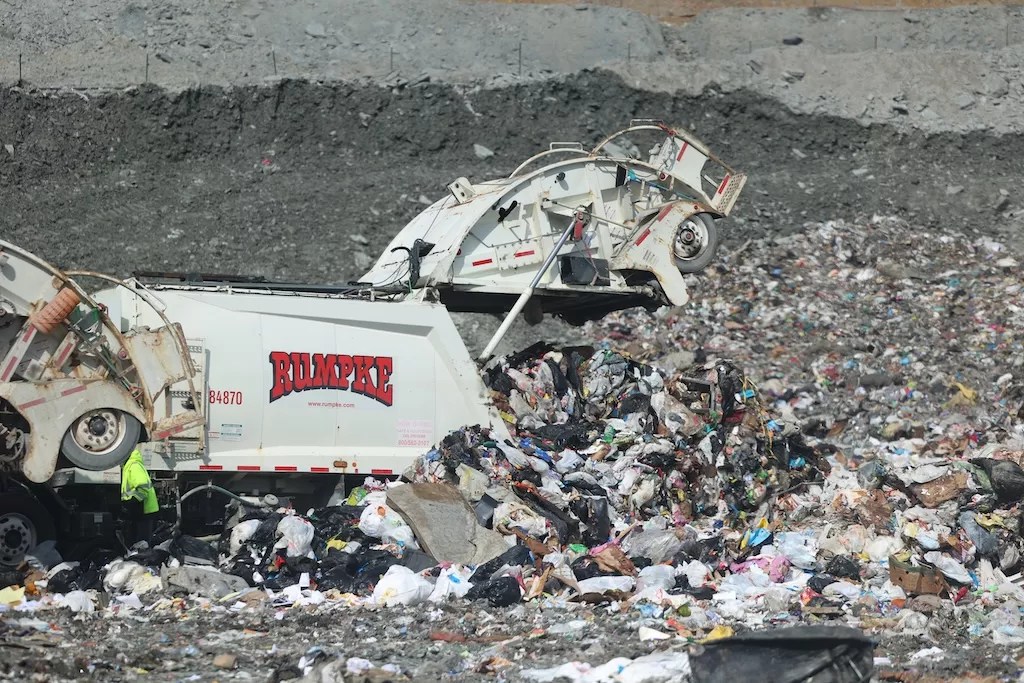
By the 1950s, the government advised against feeding garbage to hogs, leading Rumpke to shift focus entirely to waste collection. Today, Rumpke operates 14 landfills and 12 recycling facilities across Ohio, Kentucky, Indiana and West Virginia. Yeager says, “One thing that has remained consistent is this is still very much a family owned and operated company. The original William Rumpke, his grandson Bill Rumpke Junior is our president and CEO, and every day he comes to work with about a hundred of his family members. The fourth generation is in leadership positions now.” Photo: Maylea SalmonThe process begins with a garbage truck, some that compact the trash like pictured above, some that collect trash from dumpsters in parking lots of businesses and some that need to be lifted into the air by a machine to get the trash out. Each of these trucks arrives at the Rumpke landfill to begin the process by getting weighed.
“We weigh all our trucks for a variety of reasons, the first one being not every truck you see here today is a Rumpke truck,” Yeager says.
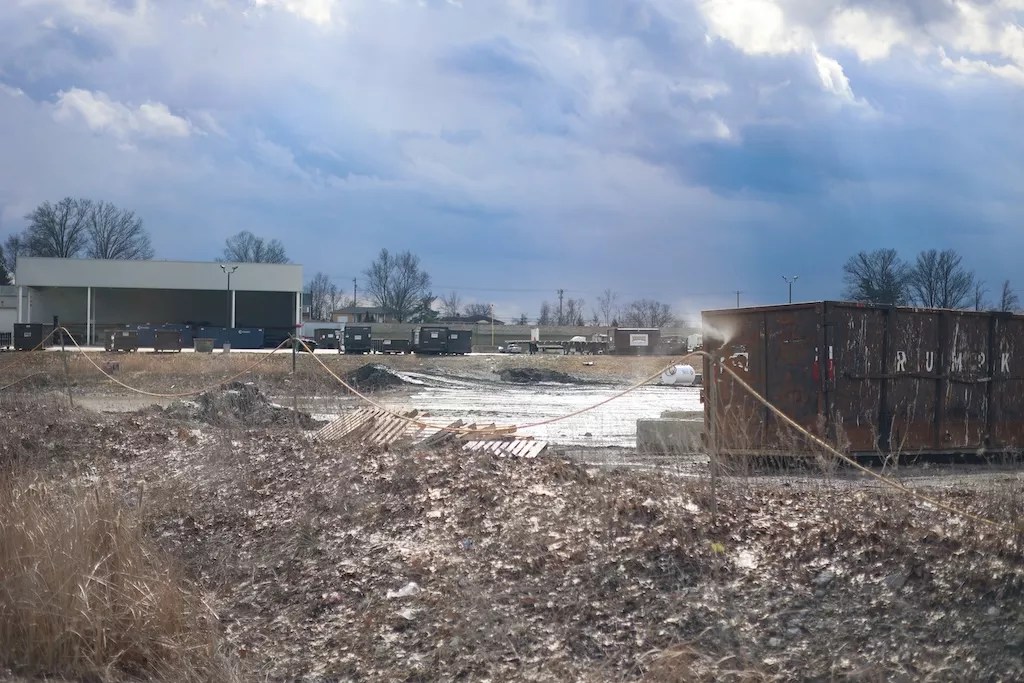
“The second reason being that we are limited on the amount of garbage we can bring in here; it’s not an infinite number. Our permit states that we can bring it up to 12,500 tons per day [to the Colerain Township landfill]. The last reason why we weigh the trucks is we have to pay taxes on all the garbage brought here. They’re called tipping fees. We pay these to Colerain Township, which is where we’re located, Hamilton County and the state of Ohio. In Colerain Township, these go to their general fund — they can use it for whatever they want. In Hamilton County, it goes to the Solid Waste District to help pay for your household waste cleanup days, tire cleanups, recycling incentives for communities and things along those lines. The taxes paid to the state of Ohio go to the Ohio EPA to pay for their programming. So, we’re talking about millions of dollars for the taxes.” Photo: Maylea SalmonThe Rumpke landfill in Colerain Township can bring up to 12,500 tons of garbage in per day. Molly says that they usually see 9,000 tons per day. “This [trash] is not coming from far away,” Yeager says. “This trash is what is produced in this region and by this region — I mean a 60-mile radius, so if you drove 60 miles north, 60 miles east, 60 miles west. 60 miles south, that’s where it’s coming from. So it’s not New York City’s trash. This is our trash. That’s what this region is capable of producing on any given day. The average person produces five pounds per day. You don’t realize it because you don’t do it all in one place. You do some at school, some at a restaurant, some at work, you know, you do it all these different places, but if you would hold onto that, on average, 5 pounds a day.” Photo: Maylea SalmonIf you are an average citizen looking to throw away a larger amount of trash, you will go through a similar process, where you will weigh in your truck and then drive to the “Citizens Convenience Center.” To provide an easier drop-off to any citizen looking to dump off a load of trash, in May of 2024, Rumpke installed this pavilion to avoid citizens having to drive back to the working face where all other trucks go to dump their trash.
“There are a mix of our trucks that are trying to get in and out pretty quickly as well as average citizens that are coming in here and emptying their loads,” Yeager says. “That way, you don’t have to go back to where all of our trucks go. This is a lot safer, cleaner and, up until May of last year, they all went back to where our big trucks go. We don’t want them mixed in with the big trucks. We have our big trucks take it back to the actual landfill. People have appreciated this because you get less flat tires, less wear and tear on your vehicle… it’s just a better, cleaner process.” Photo: Maylea SalmonContinuing down the winding road of the landfill, you will find various sections that are dedicated to specific types of waste. The one pictured is an area dedicated to composting. Composting is waste from your yard and untreated lumber that may find its way to the trash. “If you live in a community that has separate yard waste collection, it probably comes here,” Yeager says. “We work with Bzac [Landscaping] to further refine it so they come in here regularly so they can get loads and then further refine it so they can use it for mulch and composting operations.” Photo: Maylea SalmonHave you noticed that there isn’t a foul odor coming from the landfill? We did too. That is thanks to this orange tube that lines the landfill. Its job is to spray an odorless and colorless mist into the air that is made from natural extracts to “eliminate bad odor from the air. It’s like an industrial-strength Febreze,” Yeager says. Photo: Maylea SalmonThere is a large difference between a landfill and a trash dump. Yeager says that dumps were previously “on the edge of every town. You used to leave your trash there without a care — your care was that it got out of your house. Landfills came about in the 1970s and firmly put in place in the 1990s where they said, ‘Hey, we want to take better care of what’s happening with our trash.’ So they have these highly engineered structures.” Photo: Maylea Salmon“This right here is designed by an engineer,” Yeager says of the landfill. “It has an advanced liner system that makes sure that trash stays in and nothing gets in or out. So the very first thing we do is we dig a big hole in the ground. It’s about 250 feet deep, and then we put these liners in place. The very first liner we put in is three feet of re-compacted clay. And what’s neat about Colerain Township is we have an abundance of clay here, so as we dig out this giant hole, we take that clay, we refine that clay, and we put it down on the side slope to the bottom. The clay is a natural protective barrier. So, it makes sure things stay in place — so nothing’s getting in, nothing’s getting out. This clay is very thick, very dense — our engineers tell me it would take hundreds of years for a single drop of water to get through this natural clay barrier.
“But we don’t want anything to have a chance to get through that clay barrier, so we put other liners on top of that. So, this is a high-density polyethylene. This is a plastic, like the plastic that your Tide detergent bottles are made of. It’s not made out of recycled material because we want to be as strong as it possibly can be. So we put this down right on top of that clay. It looks like sheets of carpet when they roll it out, but they are sheets of plastic and then they take a machine and they weld it all together, so it’ll be a seamless sheet of plastic. In some cases, it could be 20 acres of seamless plastic, 40 acres of seamless plastic. But then we have to do all these tests to make sure the seams are holding and that nothing is getting in — no air, no water, nothing. Then on top of that, we put down this felt-like material. It’s called a geotextile and feels just like felt, maybe a little thicker, and it can’t rip or tear.
“But this is put right on top of that plastic to protect that plastic liner because, again, we don’t anything to get to that clay liner. That’s kind of like our insurance policy. And then on top of that, we put down our drainage layer. The drainage layer consists of either sand, shredded tires or pea gravel, depending on what section of the landfill we’re working on and what material we have available. We also have a series of pipes and pumps because we are going to remove something from the landfill called leachate.” Photo: Maylea Salmon“Leachate is essentially garbage juice,” Yeager says. “If it rains here, some of that rainwater is adsorbed by the garbage and it would go to the bottom of the landfill taking up space if we did nothing about it. That drainage layer is designed to pump that out so, one, it saves space in the landfill, and two, we don’t just want it sitting in there. That’s just not a great idea. We take it out and treat it with other waste water in the district so it goes to the metropolitan sewer district. Photo: Maylea SalmonNot only does this landfill have pumps for the leachate, but they also have gas wells to make sure that none of the gas produced by the landfill is released into the atmosphere. “As garbage naturally decomposes, it’s going to break down over time, some quicker than other,” Yeager says. “As it does this, it produces gas. It’s primarily carbon dioxide. So we put these gas wells in here to suck those gases out so they don’t go into the atmosphere. So, we do sweep some of the landfill to determine if we need to add more gas walls because the goal is that we don’t want any gas seeping out of the landfill and going into the atmosphere. We never intend to be a source of greenhouse gas, that’s not what we want.” Photo: Maylea Salmon“We’re trying to get all those gases out,” Yeager says. “This is a gas plan run by Montauk Energy. They actually operate three gas plants here. Altogether, they make up the world’s largest landfill gas to power pipeline. So they strip away the carbon dioxide from that usable methane, which is a natural gas, and then that gets pumped into Duke Energy’s pipeline. We supply enough gas from this landfill for about 30,000 homes for their natural gas needs.” Photo: Maylea SalmonThis is the area where Rumkpe is currently depositing its trash. Once the trucks have been weighed, they are sent here to back up and dump their trucks. The last cell (the area they were dumping trash) was 40 acres and lasted from August of 2021 until August of 2024. This landfill as a whole has 554 acres that are permitted to be used for depositing waste. Photo: Maylea SalmonLocated on the working face are two very important machines: a dozer and a steel-wheeled compactor. “A dozer who’s spreading out the material, pushing out the material, and then there’s ones that have big spiky wheels called steel-wheeled compactors,” Yeager says. “Those things weigh more than 100,000 pounds, and they have the ability to smash up things into tiny pieces that you’re never gonna recognize. So, that’s the idea — to smash it up good and tight and fit as much trash in there as you possibly can. The better we compact it and more trash we can fit in there, the longer the life we have of this landfill.” Photo: Maylea SalmonThis is a tipper truck, a very beneficial tool to transport garbage, but it comes with a drawback — it does not have the hydraulic system to empty its load without help from the machine pictured above. “Those are the ones that come from transfer stations, so they can’t empty the back so they hook up to the machine that lifts them,” Yeager says. “But they lift the back up and it allows all the trash to kind of fall out the back. These types of trucks can hold five times the amount of the rear load trucks that come here so it just really reduces truck traffic.” Photo: Maylea SalmonThe working face constantly sees trucks going in and out, as well as the dozers and the steel-wheeled compactors actively driving over the trash to smooth it over and compact it. “It’s kind of like a dance out there — you have the dozers spreading out the material and then the compactors compacting the material,” Yeager says. Photo: Maylea SalmonCompactor trucks are one of the many types of trucks that not only collect your trash but come to Rumpke to dispose of it. “A compaction truck is a rear compaction; the material gets compacted in the back of the truck,” Yeager says. “So, like this one. The driver gets out of the front, loads [the trash] into the back, then it compacts in the back.” Rumpke has thought of various ways to collect and dispose of trash in ways that are better for the environment. Photo: Maylea SalmonBirds and wildlife are a consistent presence at the Rumpke landfill, especially during the colder months when they are looking for food. This is the reason why Rumpke hires a full-time wildlife specialist through the USA Department of Agriculture. “His job is to basically harass the birds and chase them from one side of the property to the other,” Yeager says. “He does have to catalog any wildlife that is on the site. It’s not uncommon to see deer and turkey running around here. So much of Colerain is urban now, so this is their available green space. He uses pyrotechnics to shoot off like fireworks in the air that will scare [the birds] away.” Photo: Maylea SalmonRumpke’s property spreads across 1,200 acres and is located on a sediment pond. “Sediment ponds are for any water that’s not absorbed by the garbage — if it just touches our property, we still have to monitor it. Everything here is monitored and regulated. So, this is monitored by a third-party agency once a month that reports the results directly to the Ohio EPA. We also have a monitoring system so that when something goes wrong, our engineers get an alert to notify them to check it out. It’s very clean water, you’ll find fish, you’ll burn frogs, you’ll find turtles, all kinds of wildlife in there.” Photo: Maylea SalmonThere is also a list of things that Rumpke will not collect at the landfill. “We are a municipal solid waste landfill, and that means we do not take hazardous water,” Yeager says. “That includes household hazardous waste. Batteries, we don’t take those; those cause fires. Tires, you’re not supposed to put in the trash. We have a tire recycling facility right outside of New Miami. We shred those tires and we use them as a beneficial reuse as a part of our landfill liner layer, but you can’t put a whole tire in a landfill. Liquids, flammables, those type of things.” Photo: Maylea SalmonThe Rumpke Sanitary Landfill in Colerain Township Photo: Maylea SalmonWhile touring the landfill, you will find hot tubs, common household trash bags and a lot of things that could have been recycled. “We see a lot of recyclables that show us that not everybody recycles,” Yeager says. “[Recycling receptacles] are not available at a lot of events and even at apartments. They don’t all have access to it. And we know that about half of what comes in here on a daily basis could have been reduced, reused or recycled.” Photo: Maylea Salmon“You’ll see clothing come in here,” Yeager says. “Why didn’t that go to Goodwill? Like even kids’ toys that could have gone to somebody else. We are a very disposable society and people just want waste out of their house. They don’t necessarily make the extra effort…Right now, based on the current tonnage that’s coming in here on a daily basis, we estimate we have about 40 to 45 years of life left at this site. It’s eye-opening. It really is. If everybody did a good job recycling and everybody participated in recycling everything, we probably would have 80 years of life left here.” Photo: Maylea Salmon“We try to make recycling easy and we try to make it affordable, too,” Yeager says. “We try to make it affordable for people to do it. We have some communities, like the city of Cincinnati, for example, where there’s no additional cost for you to recycle. Only 65% of people participate. That’s it. We can’t seem to move that needle. Our goal is to make it easy, affordable and accessible. So, in areas where you have to pay for recycling, I think in Butler County right now, it’s around $5 a month, and I look at that and say that’s cheap compared to, you know, going to Starbucks if I’m paying five dollars for a drink. You know, this is nothing.” Photo: Maylea SalmonAt the end of the day, all of Rumpke’s trash trucks get a wash. “Basically, it’s a high-powered car wash that we have our trucks go through at the end of their day to wash away mud, dirt and garbage off of them,” Yeager says. “Why, you ask, because they’re just gonna get dirty again tomorrow. Well, for one, a clean truck smells better than a dirty truck and we will do anything and everything we can do to control odors. And two, a clean truck lasts longer than a dirty truck, and garbage trucks are very, very expensive. The starting price for garbage trucks is like $475,000 now. So, we’re gonna do anything and everything we can do to take better care of those trucks.” Photo: Maylea Salmon“All of these trucks right here are running off a compressed natural gas, so the gas we are pulling from the landfill they can pull in here,” Yeager says. “So, this is our Duke Energy tie-in, so all these trucks are hooked up to that orange line right there. It’s called a slow fill, so over the course of six hours, their trucks will be filled with a compressed natural gas. and we keep replacing more and more of these trucks with that kind of technology. It is a cleaner technology. They are quieter trucks, actually, than a diesel truck. So we keep heavily investing in this type of technology. So, really, if a diesel truck is ready to retire, we replace them with a compressed natural gas truck.” Photo: Maylea SalmonFrom humble beginnings as a hog farm to powering 30,000 homes with renewable energy, Rumpke has transformed waste management within the Greater Cincinnati area. With landfills and recycling facilities across four states, they work to highlight the impact of proper recycling and the potential to turn trash into change. Photo: Maylea Salmon