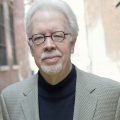
Theater programs at our universities in Greater Cincinnati often produce shows that not only offer educational opportunities for students, but also expose us to works we have lost track of or missed. David Edgar’s Pentecost is such a work, and it accomplishes what Richard Hess likes to do — challenge audiences. The head of the drama program at the University of Cincinnati’s College-Conservatory of Music is directing Pentecost at Patricia Corbett Theater Thursday-Sunday.
“There is theater that lets you escape by making you forget,” Hess says, “and there is theater that makes you escape by going deeper into yourself. Pentecost is one that takes you in.”
The action is set in an ancient, abandoned church in an unnamed Eastern European nation. It’s the early 1990s, after the collapse of communism. A painted-over 13th-century fresco has been revealed on one of the church’s walls. It appears to predate the work of Italian painter Giotto, generally credited by art historians as being the first to create three-dimensional images from a single point or perspective. The discovery could explode accepted notions about the beginnings of the Renaissance in Europe, so debate is stirring in academia. Religious and political perspectives roil matters further. As if the situation isn’t already boiling, a group of armed refugees seek asylum inside the church.
Pentecost is not an easy play. Edgar’s title references moments of God’s power in Christian beliefs. In the Book of Genesis, we learn that God divided the arrogant builders of the Tower of Babel into separate tribes with their own languages to make them humble. The Day of Pentecost in the New Testament is believed by some to be a reversal of Babel, the moment when the Holy Spirit descended on Christ’s leaderless disciples after the crucifixion with a rush of wind and flames in a closed room. That visitation gave them inspiration and new purpose, a moment interpreted by many as the beginning of Christianity.
Hess says the confusion of Babel “lives on our stage.” His 26 actors speak at least eight distinct languages from Edgar’s script — Turkish, Tamil, Arabic, Polish, Bulgarian, German, Russian and English. Hess will not use projected subtitles. How will we understand? “When you come in the door,” he says, “you will be challenged, as if you are in the church, surrounded by people you cannot understand. And yet you must. That is a skill Americans are not used to. We are used to English coming to us from the world when we need it. We will be challenged to understand without understanding.”
The play’s English dialogue is dense and heady, stuffed with the kind of meaty conversation and ideas that typify powerfully intellectual scripts by Tom Stoppard and Tony Kushner. Even characters who speak American and British English are challenged to understand one another. But for Hess’ staging of Pentecost, he wanted his actors to dig deeper.
Edgar’s script spells out foreign languages phonetically. But Hess wanted his actors to be fully prepared, so he cast the show last spring and found native speakers to coach performers over the summer. “They needed to arrive at the first rehearsal in late August fluent in their language so we could make the audience believe in our different languages,” Hess says. “It’s good for us to struggle with different languages.”
The play’s many challenges take you deeper, toward that goal of understanding. That’s what Hess likes about Pentecost.
“I have loved this play for two decades,” he says. “I hear references to it as one of the strongest plays written in the 1990s in England. But it’s unknown here. I needed the right year, the right time and the right actors. With a cast this large, it is no small undertaking.”
Hess never anticipated Pentecost’s timeliness. “I did not have the crystal ball that told me we would be in an asylum-seeking immigration crisis while we were in rehearsals,” he says. “One year ago we didn’t know that a fence was going to go up in Hungary while we were rehearsing. I chose this play because my gut said to, and now the world is telling me that we truly need to hear its message.”
Pentecost is an important opportunity to be “taken in” by theater.
CONTACT RICK PENDER: rpender@citybeat.com
This article appears in Sep 30 – Oct 6, 2015.