


When FotoFocus — the new citywide celebration of photography and lens-based art — occurs in October, there will be so many artists and venues involved it will be hard to choose which to see and when.
Making it even harder to decide among the 500-plus artists and 50-plus venues (according to fotofocuscincinnati.org) is the fact that the work of world-famous names, both historic and contemporary, will be on view along with the others: Edward Steichen, Andy Warhol, Herb Ritts and Doug and Mike Starn.
While I am looking forward to all of it, one photographer I am particularly eager to see isn’t that famous, but has certainly made an impact. Nancy Rexroth, who will be presenting new work from her landmark Iowa project, is sharing with Judi Parks and Jane Alden Stevens a show called Landscapes of the Mind: Metaphor, Archetype and Symbol 1971-2012 at YWCA Women’s Gallery. It opens Oct. 5.
Since Rexroth has lived in Cincinnati for some 20 years yet hasn’t been very active in making or showing work here, it will be good to see her get this much-deserved attention. Hopefully, this will help introduce many to her Iowa, a six-year project in the early 1970s for which she used a plastic camera to shoot haunting black-and-white images of (mostly) rural southeastern Ohio. The resultant 1977 book has long been out-of-print; copies go for around $200 on eBay. She does still have a following in the art world; Museum of Modern Art owns her work and a Minneapolis fine-art photography gallery sells vintage Iowa prints.
Rexroth’s contribution to the YWCA show won’t be large in quantity — she’s estimating somewhere between six and 20 prints. But it is promising because she has been using modern tools to go back to negatives from Iowa and develop prints of not-previously-seen images from that project.
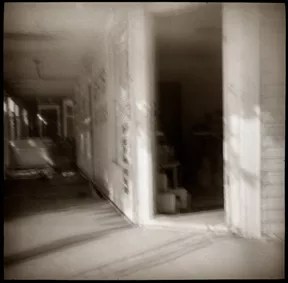
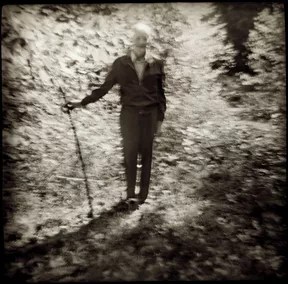
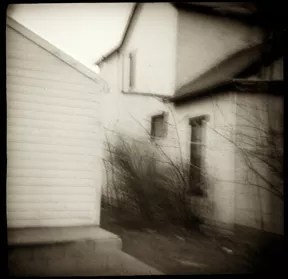
As Rexroth, who just turned 66, said during a recent interview, “I had dipped into my old contact sheets and got excited. I want to honor my work, my legacy.” (She’s provided CityBeat with several prints she’s considering using — you can see them below.)
In Iowa, Rexroth embraced the limitations of her Diana plastic camera. She produced a hallucinatory, dream-state take on a real landscape, with real people, that somehow also crystallized the way she — like all of us — filtered her awareness of the present through fleeting memories of the past. Specifically, she was remembering early trips to Iowa to visit her father’s relatives when she was a youth growing up in Arlington, Va. Somehow she was looking through southeastern Ohio — a place she frequently found sad, lonely and old — and seeing the wonderful Iowa she once liked.
It was as much an exploration of psyche as place, in a sense turning two specific, geographic states into the state of the subconscious. Her work’s soulful, frequently blurry beauty has endured. It has maybe even gained in power as what was then present, the Ohio of that vanished period, has itself become another layer of time past.
“I grew up in suburbia,” she said in a recent interview. “And the uniqueness of going back there to Iowa, it was sort of an exotic place. Everything was bright and shiny and clean. In southeast Ohio, it became like everything was decaying and you hardly ever saw people. It had this atmosphere that was like a memory or a dream. I think I was showing people a longing to want to go back and be that child.”
At the time she worked on Iowa, photographers were breaking convention to explore whatever they wanted, however they wanted to do so. They were after emotional content and wanted the freedom to find it. Rexroth’s project was the first major work to use a plastic camera; her Diana (she had several) cost about $1.50 and was considered a novelty. (An all-but-free camera was one way to pursue freedom.) She turned to it while studying photography in graduate school at Ohio University, and was able to continue with a National Endowment for the Arts grant.
Producing Iowa’s images was hard work — hours in the dark room with each negative. Prints were small, just four-by-four inches, to avoid compositional breakdown.
But getting out and using her camera was much easier. “I never would say to (subjects), ‘This is a plastic camera,’” she said. “I would just use the camera as my tool. I’m sure they were thinking, ‘What the heck is that?’ ”
Her subjects probably weren’t thinking, however, how important Iowa would become.
CONTACT STEVEN ROSEN: srosen@citybeat.com
This article appears in Jul 4-10, 2012.
