


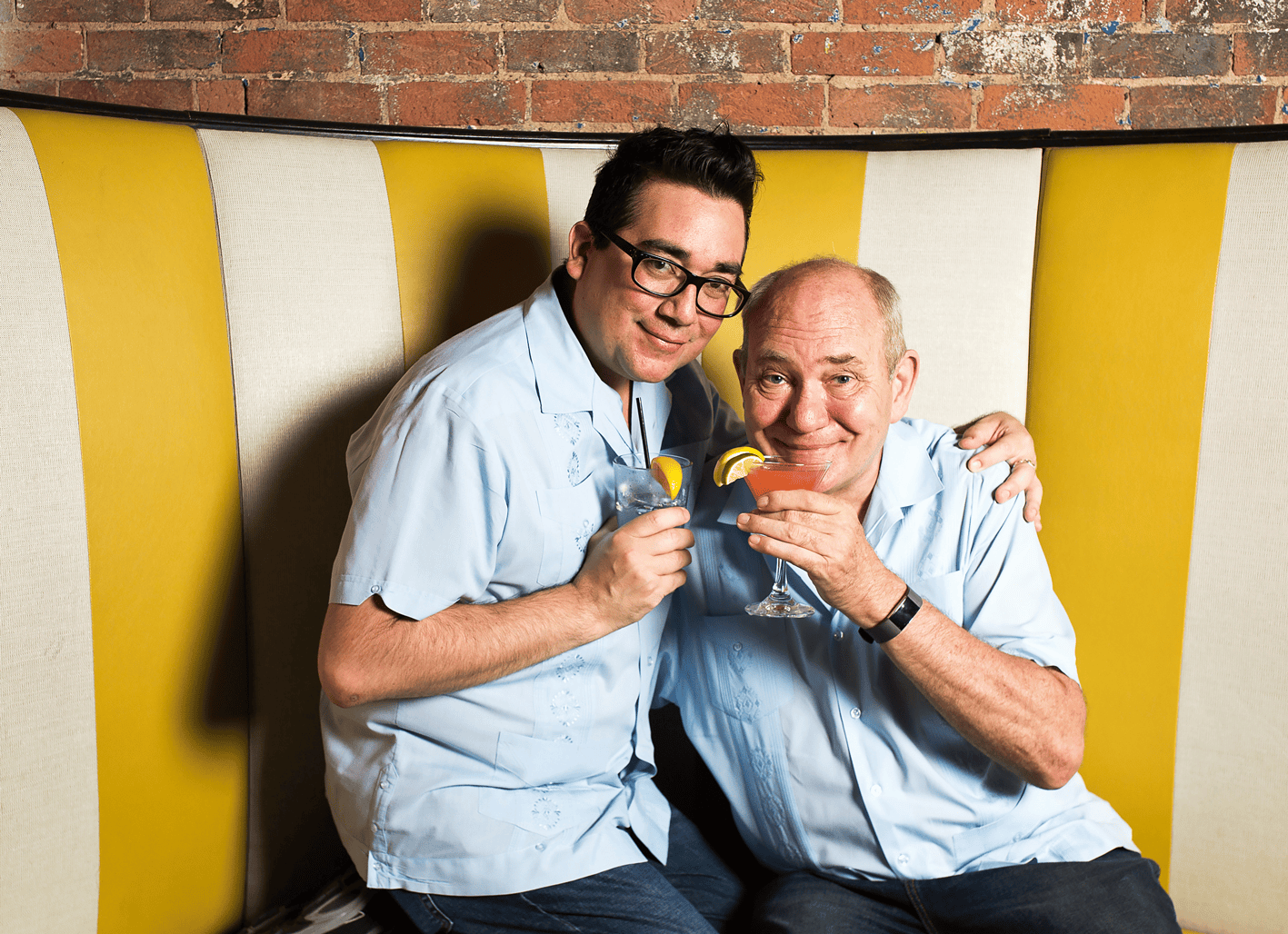
Carl should’ve just been here,” Terry Bond says of his husband, smiling. Carl Fox is at the gym, but their dog — a border collie — is weaving between bar stools. Bond reaches down and ruffles its ears. “Carl is almost the Godfather of NKY Pride.”
Together, Fox and Bond own the Crazy Fox Saloon, a Newport bar founded on the premise of serving “a friendly mix of humanity.” Scanning the space, small details mark it as an inclusive one: flyers for community events and organizations sit on the windowsill; a bowl of condoms is on a nearby table; Pride stickers on the walls and at the corner of a window let passersby and patrons know they’re safe here.
Those same markings can be found in many Cincinnati-area LGBTQ-inclusive bars, which look to build not only supportive and safe spaces, but also a larger community.
As one of those spaces, Crazy Fox is here to, yes, provide its famous bloody marys, but it’s also a local business that seeks to build bridges within the community while connecting with movements adjacent to the fight for LGBTQ rights.
“We still get people that say, ‘Oh. You’re a gay bar.’ Generally, if someone is labeling us that, they’re not supportive and they’re not with the program of trying to build bridges,” Bond says. “So, we say, ‘Look, if you want to look at us that way and you’re not going to walk in our door because of that, then fine.’ There’s a place out there for everybody, including the haters.”
Just recently, the Crazy Fox remodeled the bathroom and made it gender-neutral for customers who may not identify under the traditional gender binary.
“Carl and I travelled out West last year and it’s surprising, especially with new construction, how readily available unisex bathrooms are now,” Bond says. “It’s becoming more and more standard to deal with those issues because we’re on a spectrum. Things aren’t necessarily binary, and there are people that come in here that are on their own journey.”
The bathrooms have inner and outer locking doors in light of recent bathroom bill discourse, he says, adding that no matter what Kentucky Governor Matt Bevin does, customers can feel comfortable and safe.
In 1990, Carl ran a similar bar — Rosie’s in MainStrasse in Covington — during a time where he faced pushback for doing so. Bond notes that his and Carl’s eight-and-a-half-year age difference was stark when it came to the society they came out in.
Carl later sold Rosie’s; it’s currently run by Dianne Gamble and is still an LGBTQ-friendly destination. He met Fox in 1996 and three years later they opened their own bar a neighborhood over.
“We want everyone to come in here and feel comfortable with the understanding that most prejudice is based on ignorance and fear,” Bond says. “So, how do you break that down? You get people to mingle and get to know each other so that next time that issue comes up it’s not ‘Oh, those people.’ It’s actually one specific person that comes to mind and that you know. That’s how you change things, bit by bit.”
Success and Change
Nigel Cotterill gestures at JC Diaz and says, “He’s my partner, both in business and in life.” They laugh, taking a seat in Below Zero Lounge, the Over-the-Rhine nightclub/bar they built together 10 years ago — it turns 11 on July 3. The pair also own Northside’s Tillie’s Lounge (or, as they call it, “their baby”).
In terms of their mission, they have a similar sentiment to Fox and Bond: Below Zero is meant to be a safe haven where anyone and everyone can gather. Walk into the bar at night and you’ll see people wearing tuxes and gowns sipping on cocktails beside people in T-shirts and flip-flops.
“Some nights the bar is completely straight. Some nights it’s completely all women. Sometimes it’s all 60 (and older) people,” Diaz says. “I think that for the most part, everyone feels really welcome here and feels like they can be themselves without any judgement. And that’s important. You need to have harbors of safe spaces, especially with what the hell is going on with the world today.”
This “open-minded bar for open-minded people” has also given its space to a heap of community events. Cotterill and Diaz both laugh at a particular event in which a group of nuns rented Below Zero to raise money for haircuts for the homeless. The group played Wii bowling and, as the story goes, many-a-nun were on their second round of Long Island Iced Teas.
For another event, Below Zero hosted a deaf karaoke/dance party. The music was cranked up so loud that people who were deaf or hard of hearing could feel the vibrations through the floor. YouTube music videos, in which a person signed the lyrics, accompanied the music.
Since, the pair has made it a point to put closed captions on their TV set.
When they first opened the club in 2007, they knew they had to brand the bar as inclusive to everyone, but Cotterill says they’re fortunate the LGBTQ community planted their flag there. Each year at Below Zero, the bar hosts several events with proceeds that go toward Pride (the full calendar can be found on their Facebook) — the pair estimates they raise $5,000 annually. This year’s festivities include a one-man show by Del Shores, creator of Sordid Lives, on June 22 (8 p.m.). Then, the next night they’ll host their annual party, Absolut Pride.
One of their most popular events started seven years ago. In an upstairs room, the club holds an intimate and super popular drag cabaret on Friday and Saturday nights. Diaz says that everyone came out of the woodwork to put the space together.
“There was one point that we had drag queens up there on the sewing machines — it was like a little sweatshop — and they made all the fabrics,” Cotterill says, laughing. “We turned the place around and made it into The Cabaret.”
He reaches over and knocks a nearby table, “We’re very fortunate. We’re still here. We’re still going strong.”
In part, they say that’s due to the amount of organizations and people they have connected with — the Cincinnati Men’s Chorus, pet adoption groups and more.
“Being exposed to Europe and most of the country, it was pretty evident that, somewhere down the line, the day of the gay bar was going to be gone,” Cotterill, originally from England, says. “The internet certainly kills it.”
Before the internet boom, the LGBTQ community had to go out and socialize in order to connect. Now, Cotterill says, you can just click online and connect that way. Diaz, from San Francisco, says that many bars have now closed, even in his hometown’s LGBTQ Castro District.
When Cotterill and Diaz travel, they see similar patterns elsewhere. In Cincinnati alone, Cotterill says that at one time he counted 27 gay bars between Cincinnati and Northern Kentucky. Today, many have shut their doors.
The Crazy Fox’s Bond says that several of the businesses that have gone under over the past few years haven’t necessarily been because of lack of business. The bar On Broadway, he says, went down because of structural issues with the building.
Earlier this year, on Valentine’s Day, the community suffered a major blow when downtown’s The Dock closed its doors due to city renovations on the Brent Spence Bridge. It had served the LGBTQ community since 1984 and built bridges through social activism. In the mid-’90s, it was home to Cincinnati’s Pride Festival. The owner, Rob Corman, told the Cincinnati Enquirer The Dock may be able to relocate.
“Now, it’s about finding a location,” The Dock’s entertainment director Jessica Dimon told media in February. “It’s about getting the right place because we really desperately need something for the gay community, somewhere we can call home.”
When the long-standing bar initially announced their closure, patrons showed an outpouring of love on Facebook. One commenter said it was the first gay bar they went to. A few said that they met their now-spouses at the spot.
Other long-standing local LGBTQ bars that have shuttered in recent years include Shooters, Simon Says and Club Glitter.
“It’s interesting now because there is a certain amount of nostalgia for out-gay bars,” Bond says. “Rosie’s and a few other places as well and our place — the movement was to try and be a broader spectrum because you need allies. …But now we’ve made so much progress on many levels that some people are saying ‘OK, I want a space that is just for us.’ But how can you be that exclusionary now?”
He adds that it’s an interesting conundrum currently in the LGBTQ community.
Work to Be Done
When Carl first sold Rosie’s, Bond says they had only been together a few years. Carl wanted to move to a more progressive city, but Bond still had his family and a younger, teenage brother. Northern Kentucky was home. So, they stayed.
“The other part of that is that this is still the frontier in terms of rights and equality. There’s a struggle,” Bond says. “This is still the front line, so it’s important that there are still people here holding that line and moving it forward and that’s part of what our mission has been as well — moving that line forward.”
He’s seen that change. The couple was hailed as NKY Pride’s first Grand Marshals for the region’s parade, which had its second run in early June this year.
“One of (Carl’s) first Pride marches in the late ’70s, he said they were outnumbered by counter-protestors,” Bond says. “They were yelling things and the police were there more to protect people from this horrible crowd. Now, it’s striking. You go to Cincinnati Pride and it’s block after block after block. It’s wonderful to see all the different elements involved: the political support, the business support. It’s progress.”
But being at the front line of one movement also means working to prop up other communities, he adds. There’s still work to be done post-marriage equality, but Bond says it’s important to look what other groups are behind them.
“There’s always going to be someone working their way up this ladder,” he says. “The question is, do you stop where you’re at and mind your own or do you turn around and help? We have a responsibility with the success we’ve had to turn around and help other groups.”
He cites the Hispanic and Islamic communities, as well as the #MeToo and Black Lives Matter movements as examples.
“It’s important that we all stand together for one another as much as possible because suddenly if their fight is our fight and our fight is their fight and we line up together — we’re the majority,” Bond says. “Then, all of a sudden, straight white men are a minority like everyone else. The hope is that we can all work together and find a common cause.”
In their own way, through a business they’ve raised together to become more than a bar, but also a necessary hub of community, they have continued to push that line forward.
Times Have Changed
On 2008’s election night, Below Zero was buzzing.
“We were all sobbing and crying. The bar was packed and everyone was watching the one TV we had way back when,” Diaz says. “We were all glued to the television when they made the official announcement (that Barack Obama had been elected president) and people just cried and cried. Everyone was hugging one another.”
Cotterill adds that they don’t affiliate themselves with any political party. He’s always said that politics, religion, guns and children are kept out of the bar.
“But, you know, people migrate to where there are people of a similar mind are, so,” he says. “We’re open to spreading the word here. I just hope people vote, because once you vote you can complain.”
They want their clientele at Below Zero to be politically active. So does Bond, who says that though the Donald Trump administration has been “horrific,” it’s also been a catalyst for mobilizing people and movements.
Love of Community
Bond says his husband, Carl, always speaks to reporters or television stations about issues like marriage equality. He puts himself out there. In 2003, a letter was slipped in the bar’s door, addressed to Carl.
On the front, the return address depicted a swastika and the term “wendepunkt,” or turning point. The police came, opened the letter and told him that it was death threat. They called the FBI; two other letters had been sent in the region.
A reporter caught wind, got their input and published a story. A few days later they got a phone call from their bartender, who told the couple to come to the bar right away.
“We get our stuff together and come down and our bar is packed with all of our neighbors,” Bond says. “The word had gotten out because we had built a relationship with our community. We got a beautiful letter from one of the city commissioners about being the fabric of Newport and ‘Don’t let this intimidate you. We have your back.’”
He says the outpouring was amazing, but the night didn’t end there. Their neighbors pulled together monetary pledges to try and catch whoever committed the fear tactic. It turned out to be a man in his late 50s/early 60s living northeast of Cincinnati. For the offense, he got two-and-a-half years in prison.
They read a letter during his sentencing to help Carl find closure. They wanted to make sure that it was clear that they believed this man should find help while in prison. And that, though he wanted to intimidate them, he ended up doing the opposite.
“Everything you did caused our neighbors to come out and support us. We know now more than before that we’re in the right place doing the right thing,” Bond says. “Understand that we’re not alone and our neighbors are with us. The way our community responded; it was really amazing and extraordinary to us to know that we have that support behind us and we’re doing the right thing.”
Importantly, they didn’t act out of anger.
“We have a mission. And I think it’s important for every business to have a mission and purpose of what you’re doing other than keeping the lights on and paying the bills,” Bond says. “And for us, it’s about making our community better.”
*A previous version of this story identified Terry Bond as Terry Fox.
This article appears in Jun 13-20, 2018.
