


For decades, housing advocates, the U.S. Department of Housing and Urban Development and various state agencies have worked to break up the stubborn economic and racial residential segregation found in many American neighborhoods.
Increasingly, that effort has come through the federal Low-Income Housing Tax Credit program (LIHTC), which aims to incentivize private developers to build affordable rental housing that would otherwise be impossible in the real estate market, widening the choices available to low-income residents and breaking up concentrated poverty.
But a look at the results of that program in Ohio shows that credits are very often granted to development projects in low-income, often minority neighborhoods, continuing housing segregation and offering few new choices for those looking for mobility.
Advocates say that’s exactly what the program was designed to avoid and want the state to adjust how it hands out the credits. But some experts point out that those low-income neighborhoods need investment, too, and that programs shouldn’t only try to funnel poor people out of them.
“We really have clients who want choice,” says Steve Sharpe, a lawyer with Southwest Ohio Legal Aid, who worked on a recent study of LIHTC credits in Ohio. “There are some who want to live in communities where they grew up — they want those strengthened, and that’s totally cool. But there are some people who want an opportunity to move to other places. It shouldn’t just be white middle class people who have a choice in where they live.”
Southwest Ohio Legal Aid Society commissioned its study in cooperation with other legal aid societies throughout the state. It found that 83 percent of the 34,000 units created in Ohio with funding from the LIHTC program between 2006 and 2015 were in neighborhoods with poverty rates above 20 percent. A quarter of LIHTC units were in neighborhoods that were more than 75 percent black with poverty rates above 40 percent, compared to just under 3 percent of all housing units in the state.
That’s an especially important dynamic in Cincinnati. CityBeat last year documented the pervasive economic and racial segregation that divides the city, analyzing Census data to find that nine of the city’s lowest-income neighborhoods are predominantly black and that nine of its highest-income are predominantly white, leaving many minority residents trapped in the same low-income neighborhoods for generations (see “That Which Divides Us,” issue of Aug. 26, 2015).
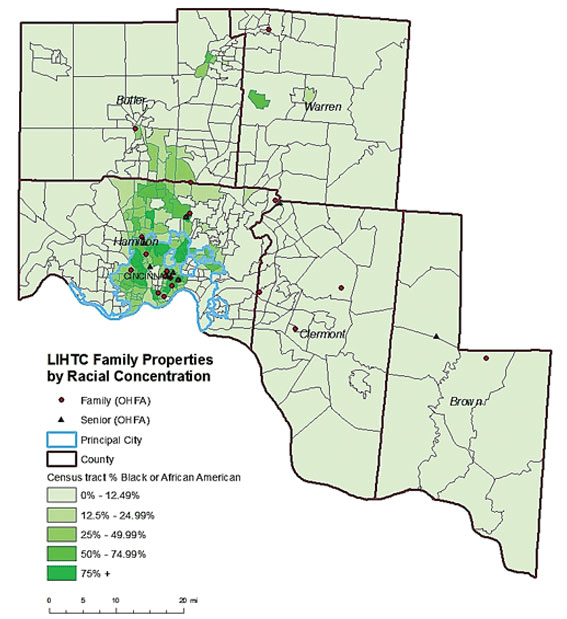

In Hamilton County, LIHTC has helped fund more than 140 affordable housing developments since 1986, many of them in the city of Cincinnati. Sixty-seven percent of LIHTC awards in the county between 2006 and 2015 worth more than $24 million went to projects in neighborhoods where more than 40 percent of residents live in poverty. There were a few exceptions — a project in Loveland and another in Springdale are recent examples — but, overall, only 13.4 percent of the credits went to projects in areas where the poverty rate was less than 20 percent.
The LIHTC program is part of a long line of efforts to provide affordable housing to low-income people. The first federal efforts at comprehensive affordable housing came in the 1930s with public housing projects, typified in Cincinnati by places like Laurel Homes and Lincoln Courts in the city’s West End.
But by the 1970s, it was becoming apparent that those housing developments segregated low-income residents — many of them minorities — in a few isolated parts of town, often away from educational and work opportunities. Congress in 1974 created the Section 8 Housing Choice Voucher program, which sought to give low-income tenants wider choices on the housing market by subsidizing rents to private landlords. That program has had its own shortfalls, however.
“The whole idea of Section 8 in the beginning was that it was going to allow people to get out of the ghetto,” said Mike Daniel, a lawyer for the Inclusive Communities Project, in an Atlantic article about Section 8’s failings last year. “But there’s tremendous political pressure on housing authorities and HUD to not let it become an instrument of desegregation.”
Currently, the waiting list to get the vouchers in Hamilton County is long — more than 1,000 people — and there aren’t enough landlords renting to Section 8 tenants anyway. That’s where LIHTC, created in 1986, can help, advocates say.
“That’s actually a really critical dovetail in programs,” says Sharpe. “What is so important about tax credit developments is that they have to take vouchers. And, you know, vouchers are really supposed to be a tool for this sort of mobility. The problem is, landlords don’t have to take them, generally, and you find voucher patterns that mirror public housing patterns. So tax credit developments can help disperse that voucher usage because they must take vouchers.”
Now responsible for about 90 percent of subsidized housing development nationwide, according to HUD, the credits work like this: A developer looking to build affordable housing proposes a project to the Ohio Housing Finance Agency, which uses a complex rubric taking into account things like the project’s proximity to transit, services and educational opportunities to determine who to award the credits to in a competitive process. Should a developer win the credits, they raise capital by in effect selling them to an investor, who then applies them toward income from other sources.
But within the LIHTC process are extra incentives and market pressures that often steer developers almost exclusively toward low-income neighborhoods. Chief among them is a 30 percent boost in subsidy available for developments in particular low-income neighborhoods called Qualified Census Tracts, where most residents make less than 60 percent of an area’s median income.
Often, those neighborhoods also happen to be where minorities are located, says University of Cincinnati real estate professor Mike Eriksen, an expert on LIHTC credits. He says that putting the developments in those places isn’t necessarily bad in and of itself.
“You need to understand the counter-factual and what would’ve been located in the projects’ absence,” he says. “In this sense, most of LIHTC subsidized housing is much higher-quality housing than either the vacant lot or abandoned building that would’ve been there.”
There are also social dynamics that play into the selection of the projects. One key factor OHFA uses when scoring applications for the tax credits is community engagement and support, something that can be hard to secure in higher-income neighborhoods where residents may have reservations about subsidized housing.
That’s something Jeniece Jones, executive director of Cincinnati’s Housing Opportunities Made Equal, sees often.
“We know there will be local pushback,” says Jones, who would like to see more LIHTC projects in higher-income areas. “We know there will be some [not-in-my-back-yard] mentality.”
Eriksen says there are new HUD efforts to expand affordable housing in higher-income neighborhoods, including a new 30-percent subsidy boost given to projects in high-income ZIP codes that went into effect this June. Beyond that, however, Erikson says the focus shouldn’t just be on giving people opportunities to leave low-income communities.
“I feel strongly we need to invest in attributes and amenities in traditional low-income neighborhoods that low-income people value, like good schools, lowering crime, public transportation, accessible laundries,” he says.
Jones agrees, but says LIHTC allocations should be about “balance.” It’s important to keep working to extend choices for low-income tenants, she says.
“We have a lot of clients who have HUD choice vouchers who would like more choices. I don’t want people to give up and feel like there’s no point in trying” to find options in middle class and upper-income neighborhoods, she says. ©
This article appears in Sep 28 – Oct 5, 2016.